



Welding processes
焊接方法
In plain words
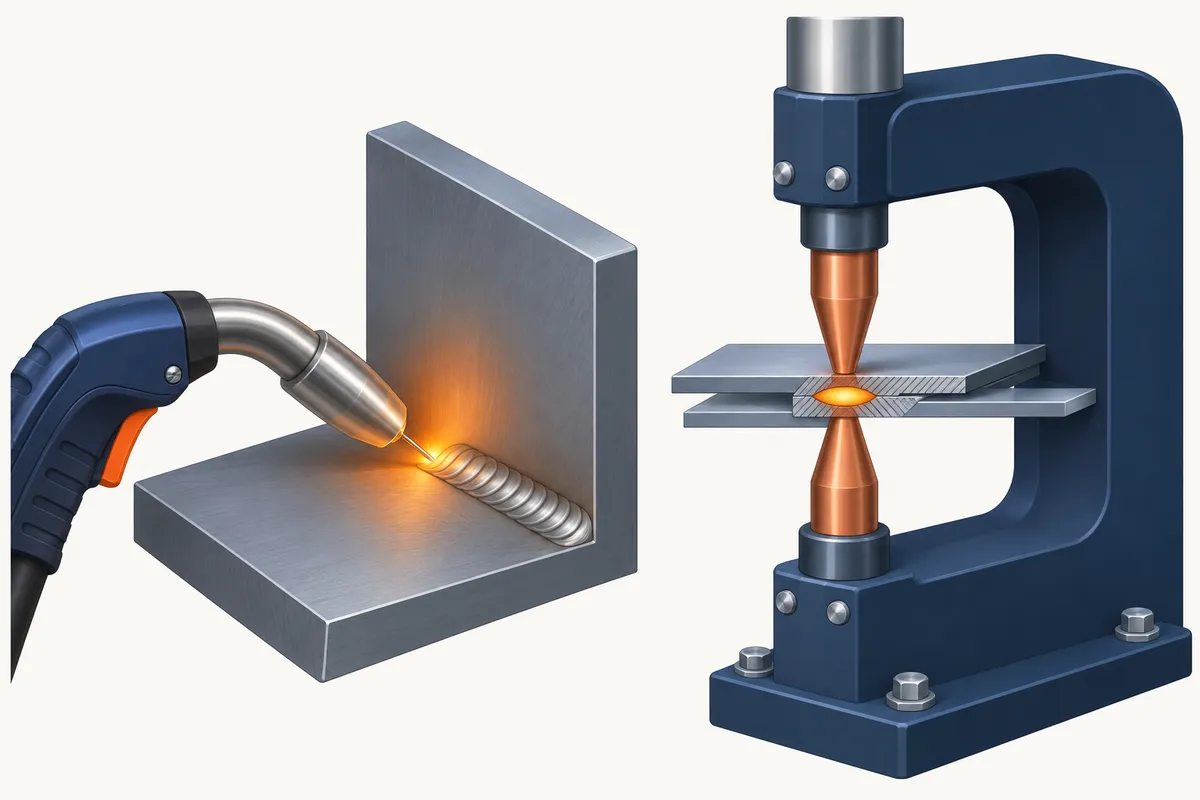
Welding joins metal with metal. An electric arc or a laser makes a spot hot enough to melt the edges of both pieces, often with a melted filler wire added; when it cools they are one piece. Different methods suit thick steel, thin stainless steel or the sheets of a car body.
What it is
Welding melts the edges of two parts, usually with added filler metal, so they fuse into one piece. MIG/MAG welding feeds a wire electrode through the gun under shielding gas; it is fast and the workhorse of steel fabrication (in China often CO₂-shielded, 二保焊). TIG welding uses a tungsten electrode that does not melt and a separate filler rod; it is slower but clean and precise, for thin stainless steel and aluminium. Stick welding suits site and repair work. Resistance spot welding squeezes two sheets between copper electrodes and passes a large current, joining them at a spot in a fraction of a second, the standard for car bodies and sheet assemblies. Laser welding makes narrow seams with little distortion and is now common in handheld form. Robots run MIG and spot welding at volume.
Why it matters for products
Weld cost is weld length times the time per metre for the process and size, plus fitting up, tacking, cleaning and grinding; the process follows material and thickness.
Learn first
Opens the way to
Making a part like this? Plan the process and estimate costs in Workspace.