



Stamping and press dies
冲压与冲模
In plain words
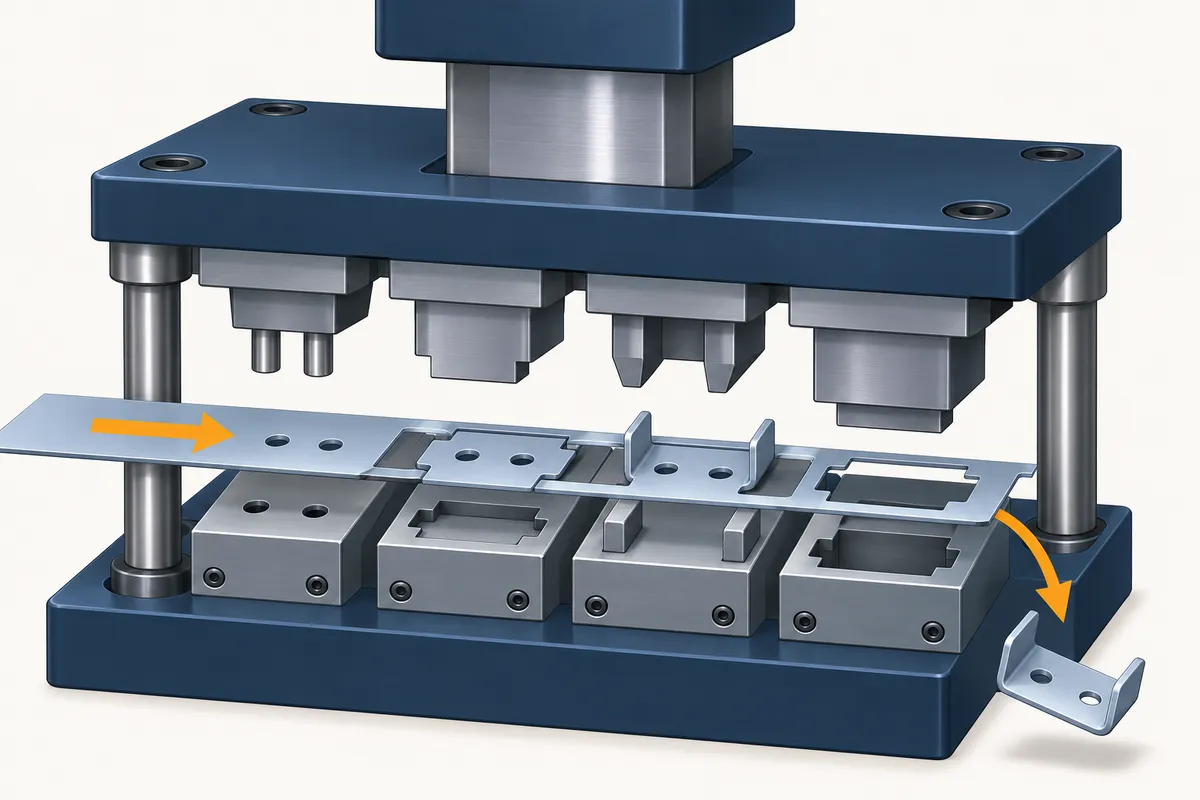
For huge numbers of the same part, a press slams a hardened steel tool onto the sheet and a finished part comes out with every hit. The tool is expensive and takes weeks to make, so it pays only for large numbers of parts; how many depends on the tool’s price and how much each part saves.
What it is
For thousands to millions of parts, a press closes a hardened die set on the sheet and cuts or forms the part in one stroke, many strokes a minute. A progressive die feeds a strip through a row of stations, each doing one step (pierce, notch, bend, form, cut off), so a finished part drops out at every stroke; deep drawing forms cups and cans; a transfer press moves larger parts between dies. The die is a costly one-off tool, made in a tool shop by milling, wire EDM and grinding, and takes weeks to build and try out. Stamping wins on piece cost; laser cutting and press brake bending win in small batches and while the design may still change.
Why it matters for products
The break-even quantity between laser plus brake and a stamping die is a process-selection rule; the die cost is spread over the expected volume.
Learn first
Making a part like this? Plan the process and estimate costs in Workspace.