



Vacuum casting
真空复模 / 硅胶复模
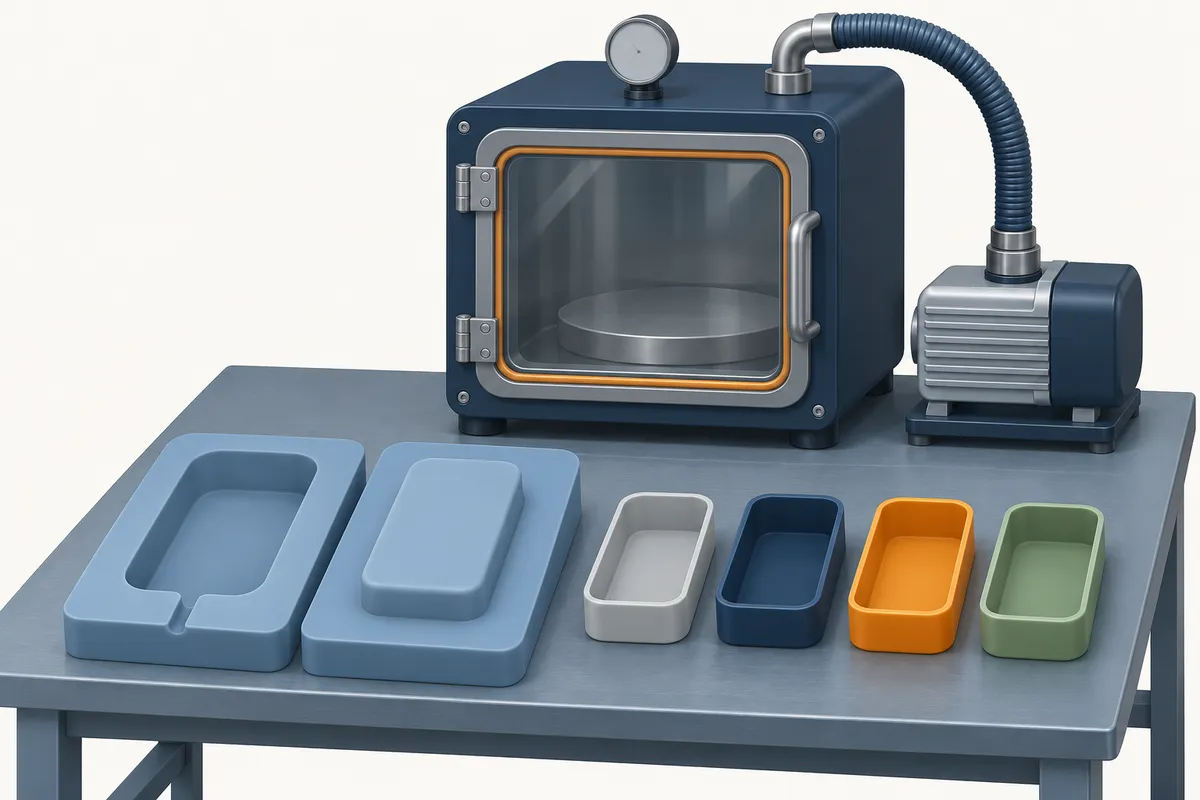
In plain words
A way to make a few dozen plastic parts without paying for a steel mould. You make one perfect part, pour soft silicone rubber round it to make a mould, cut it open, then pour liquid plastic in, like making jelly in a rubber mould. Each rubber mould lasts for roughly twenty parts before it wears out.
What it is
A way to make tens of plastic parts that look like moulded ones without an injection mould. A master pattern, usually CNC-machined or printed (154) and finished to the surface wanted, is hung in a box and liquid silicone rubber is poured round it. Once cured, the silicone is cut open along a planned parting line and the master removed, leaving a soft mould. Two-part polyurethane resin is mixed and poured in under vacuum to draw the air bubbles out, then cured, often in a warm oven. Resins imitate ABS, PC, PP and rubbers of different hardness. A silicone mould typically lasts about 15 to 25 castings before it loses detail, so larger runs need more moulds. Accuracy is looser than machining, and large flat parts, very thin walls and true engineering plastics are its limits. Chinese prototype shops (手板厂) offer it as a standard service.
Why it matters for products
The quote option between machining and moulding, often the cheapest route for a few dozen parts, priced as master plus moulds plus resin and labour per part, with a lead time of typically one to two weeks.
Learn first
Making a part like this? Plan the process and estimate costs in Workspace.