



Mould and die making
模具制造
In plain words
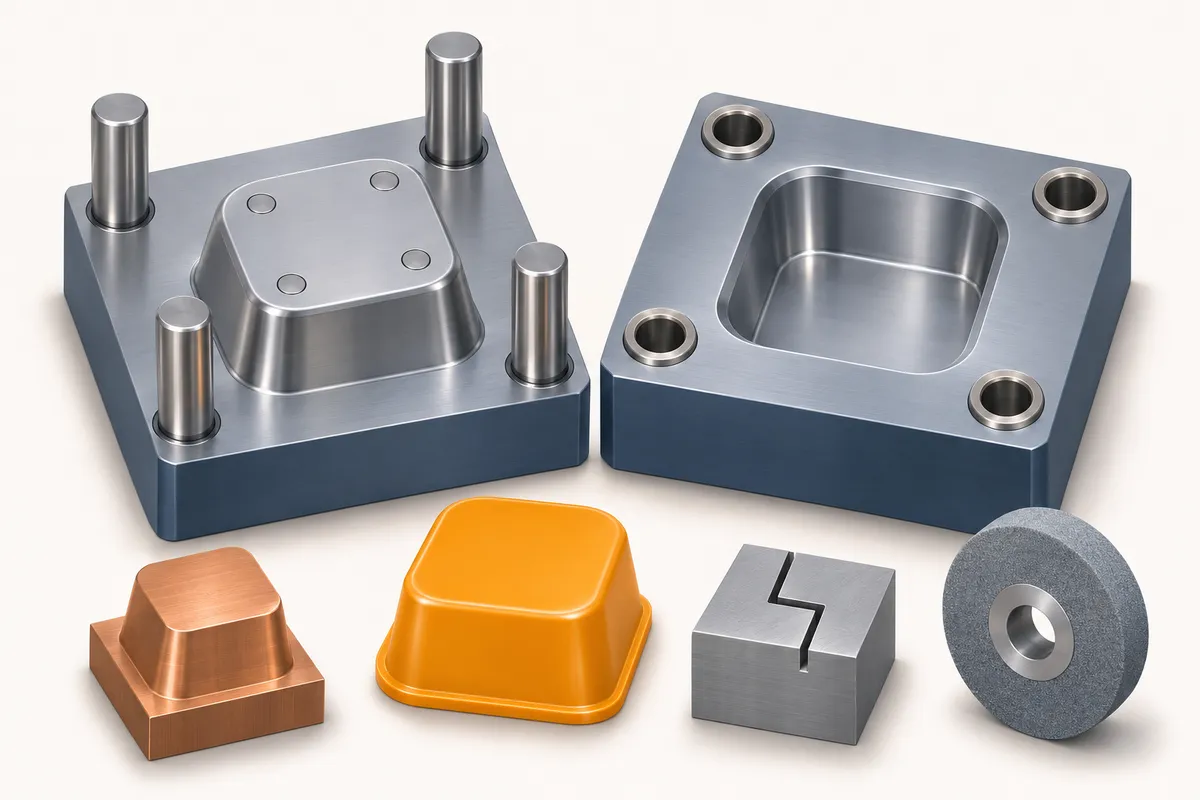
Moulds and dies are the tools that make other parts: the steel blocks that shape every plastic bottle cap or stamp every car door. Each one is a one-off in very hard steel with tiny, exact details, so tool shops use sparks and grinding as much as cutters.
What it is
Moulds for plastic injection and die casting, and dies for stamping and forging, are one-off tools made of tool steel: P20, supplied pre-hardened and machined as it comes, or H13 and D2 (in China Cr12MoV or Cr12Mo1V1), which are hardened during making. A typical route for a hardened tool: rough mill soft, heat treat, then hard mill, wire-cut the through profiles, sink EDM the ribs and sharp corners, grind the plates and punches, polish, assemble and try out on the press or moulding machine. Standard mould bases, guide pillars and ejector pins are bought in. Quantity is one, accuracy and finish are high, and lead time is weeks. Tool shops (模具厂) are the largest users of wire EDM, sinker EDM and precision grinding.
Why it matters for products
A quoting world of its own, priced from the complexity of cores and cavities, the number of electrodes, EDM and grinding hours, bought standard parts and the try-out rounds, not from a cycle time per part; in China it is a large market for CAM and shop software.
Learn first
Opens the way to
Making a part like this? Plan the process and estimate costs in Workspace.