



Turning between centres and slender shafts
顶尖装夹与细长轴车削
In plain words
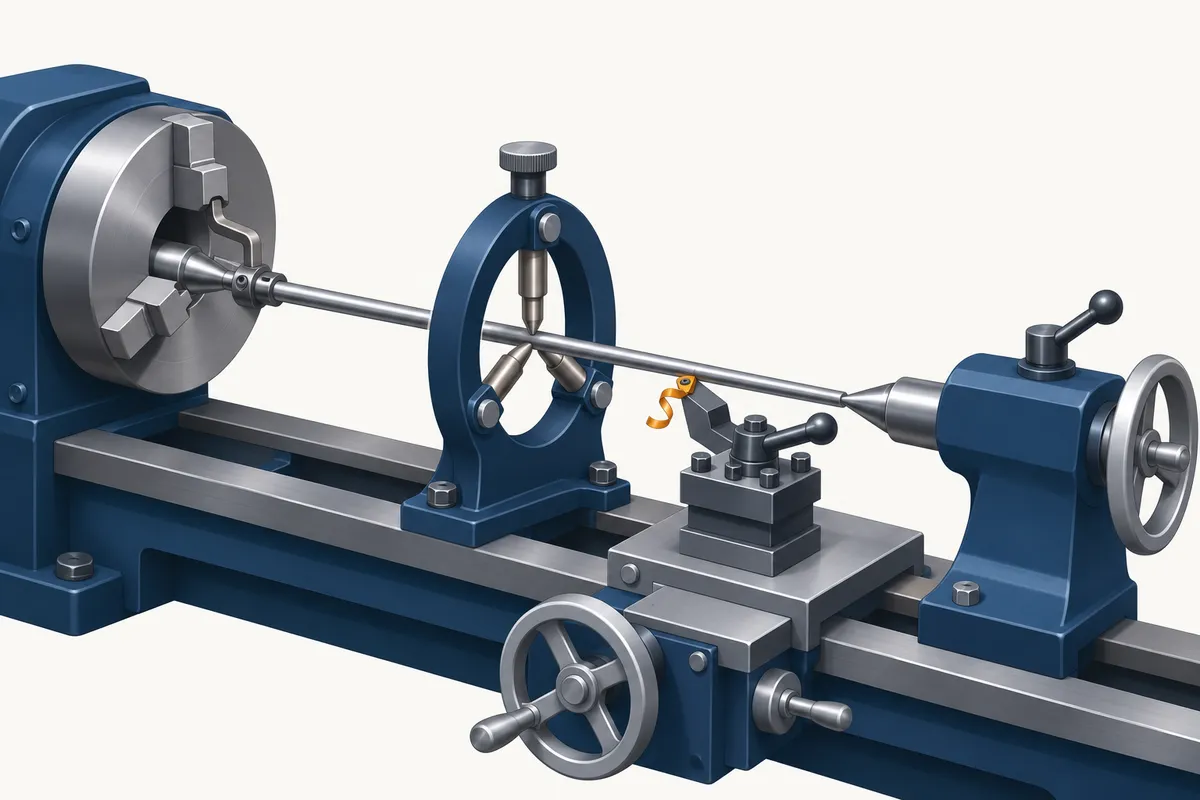
A shaft can be held by a pointed cone pushed into a small hole at each end, like a roast turning on a spit. Because it always spins about the same two points, every diameter comes out in line, even after the shaft is turned round. A long thin shaft bends away from the tool like a fishing rod, so an extra support holds it steady.
What it is
Precise shafts are often turned and ground between centres. A centre drill makes a small 60° conical hole (中心孔) in each end, in standard forms (GB/T 145 in China). The part then sits between a centre in the headstock and one in the tailstock and is driven by a lathe dog. In the tailstock a dead centre does not turn and needs grease, while a live centre runs on bearings. Because every diameter is cut about the same two holes, the part can be turned end for end (调头) and still run true, and the same centres serve for grinding (136) and runout checks. A long, thin shaft bends away from the tool and chatters (36). Beyond roughly ten diameters a steady rest (中心架) fixed to the bed supports it at one point, or a follower rest (跟刀架) rides with the carriage and supports it close to the cut; Chinese textbooks call a shaft longer than about 20 to 25 diameters a slender shaft (细长轴). A sharp tool with an entering angle near 90° pushes the shaft away least.
Why it matters for products
A shaft's length-to-diameter ratio decides support, speed and the number of passes, and centre holes are a feature the drawing may ask to keep or remove.
Learn first
Making a part like this? Plan the process and estimate costs in Workspace.